You have just read a blog post written by Jason McIntosh.
If you wish, you can visit the rest of the blog, or subscribe to it via RSS. You can also find Jason on Twitter, or send him an email.
Thank you kindly for your time and attention today.
Well, I had a fairly productive year in the realm of small-stakes media. I got to guest twice on one of my favorite long-running game podcasts, and produced six more episodes of my own show. I also invested significant time into new audio production skills, though I don’t have much to show for it just yet. And I waded around a bit with freelance article writing for the first time in many years.
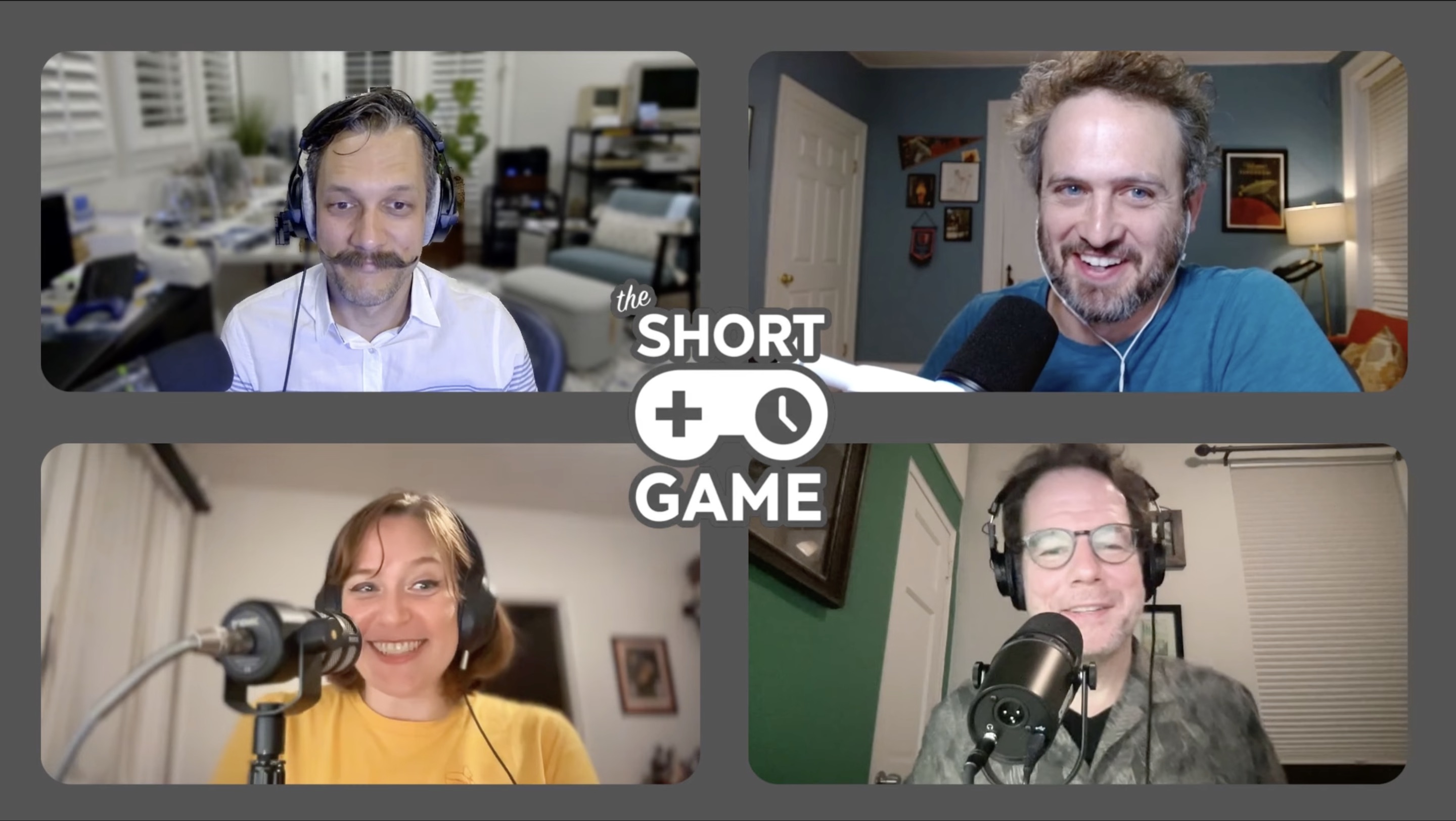
I guested on two episodes of The Short Game:
Episode 430, a general chat about the Steam Deck game console, for which I am known to have a certain affinity. (Also on YouTube.)
Episode 443, discussing fan-made remakes and remixes of older commercial games that are playable on the Steam Deck. (Also on YouTube, or you can just skip to my cat interrupting us.)
The Short Game has been one of my favorite podcasts for some ten years now, ever since they started covering IFComp, during the brief window I was in charge of that annual competition. It’s literally the only game-related media I have consistently followed over this whole span. The chance to be a part of it like this—twice!—was an absolute delight. The show just today returned to the air after a half-year hiatus, and I hope I can revisit its virtual studios soon.
I recorded another six-episode season of Venthuffer, my strictly-audio-only podcast that was originally about the Steam Deck, but clearly wanted to be more about video games in general, or even just topics tangential to the way that I approach video games. I count the final two episodes—a profile of game auteur Jeff Minter, and a genealogical dive into “Halstrick”, my chosen gaming handle—among the best self-contained works of audible media that I have ever made.
I really do want to get back to Venthuffer, and I even know what I’d like to record next. However, an unexpected late-summer opportunity temporarily redirected my energy and attention for audio production into another outlet, as follows.
I’ve long been interested in developing more audio narration skills, particularly with audiobooks. After serendipitously gaining a new mentor in this field in August, I spent the final third of the year pouring much of my attention into audiobook production, by way of ACX. From September through December, I recorded the following, each after a successful ACX audition:
A very short self-help book.
Another short book about generative AI, which I didn’t realize was itself absolutely AI-generated until halfway into the project.
An anthology of two dozen essays from professional horror-genre authors, sharing stories and advice on the craft of writing fiction, and the science of selling it.
The first two audiobooks have now been published—the second under a pseudonym—but I’ve chalked them up as educational experiences that I need not name, let alone link to. They have each sold one or two copies, and I’m fine with that.
The third audiobook is still under review by its rights-holder, so I can’t name it yet either. But I do very much hope for its publication early in the new year. When that happens, I plan to share far and wide. It’s gonna be a good one.
I had three paid articles published in Linux Magazine, which has kindly allowed me to host and share PDFs of them:
A profile of the Steam Deck from the perspective of a Linux user curious about exploring the machine’s open-source underpinnings, using only the software and services that the game console ships with.
A guide to finding, installing, and using “mods”—fan-made software that modifies the behavior of commercial games—on your Steam Deck.
A high-level overview of creating parser-based interactive fiction games using Inform on Linux.
I also wrote one article for LWN.net about Memcached.
I enjoyed working with both of these publications. My time and attention for this sort of writing got absorbed by job hunting and then BumpySkies in the latter part of 2025. I look forward to writing more articles about doing interesting things with Linux, once I have enough attention freed up for it.
To that end, I intend to be kind to my attention span in 2026—which is to say, I intend to meter it out with fiercely guarded care, so that I can keep working with brilliant people to put small and interesting things out into the world. May the new year bring you, too, enough of a peaceful reset to let your attention remain sovereign.
To share a response that links to this page from somewhere else on the web, paste its URL here.
If you enjoy Fogknife, you might also like these websites. (See also an expanded edition of this list.)
 jmac@jmac.org
 @jmac@masto.nyc