You have just read a blog post written by Jason McIntosh.
If you wish, you can visit the rest of the blog, or subscribe to it via RSS. You can also find Jason on Twitter, or send him an email.
Thank you kindly for your time and attention today.
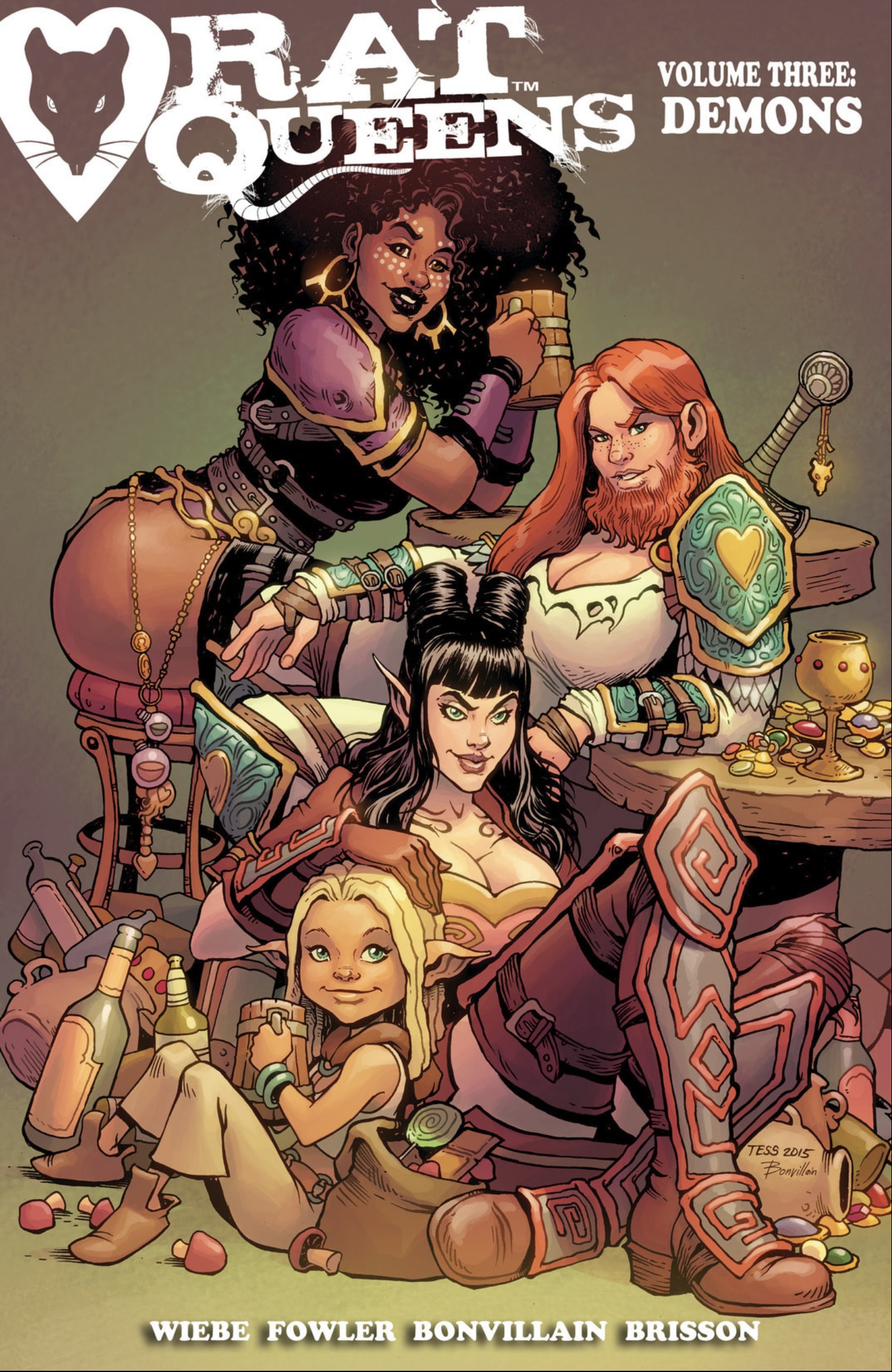
Comics critic Sean Kleefeld summarizes the bad vibes around Rat Queens, an otherwise fondly recalled American high-fantasy series introduced in the 2010s.
Rat Queens had earlier this year returned to my own attention as one of the primary design inspirations for His Majesty the Worm, a marvelous new tabletop role-playing game by Josh McCrowell that I recently discovered through happenstance. Worm, like Rat Queens, takes place in a Legally Distinct From D&D™ World where small, themed troupes of adventure-weirdos hire themselves out as freelance quest-chasers; ceaseless gags and spectacular violence ensue. I had read the first few story arcs some time ago, and loved to see its ideas already mixing in with other media. I’ve been happily pushing this comic book on the friends with whom I’ve been enjoying Worm.
And so it’s with some disappointment that I learn that the book has baggage, largely around its founding artist Roc Upchurch. He left the series about a year after its launch after he was arrested for domestic abuse. As Kleefeld notes, that case is non-debatable, with all facts on the public record, including the aggressor’s confession. Far thornier—and, by Kleefeld’s telling, never satisfactorily settled—is the writer Kurtis J. Wiebe’s apparent attempts to re-engage with Upchurch without consulting replacement artist Tess Fowler, causing the latter to quit the project. (Wiebe left a comment on Kleefeld’s post, disagreeing with certain details here.) It sounds like the project’s been in a kind of creative limbo since then, re-appearing in the comics-cultural radar for occasional projects like a new crowd-funding campaign for a Rat Queens game. This is the event that got Kleefeld’s attention—and which moved him to write his critical post, since he saw none of the press about that campaign mentioning the book’s troubled past.
Boy, do I find this exasperating right around now, even though Upchurch’s arrest happened more than ten years ago. But I learn about it right after Graham Platner has powered his way through his own abuse allegations to defeat a popular sitting governor in a race for Senate candidate. And I learn about it a couple of weeks after a close friend checked me on my repeated and uncritical sharing of stuff from Warren Ellis’s newsletters, this being a writer whose ongoing work I still admire even as dozens of women continue to hold him accountable for years of sexually coercive behavior. And processing the Ellis stuff led me—finally, after more than a year of averting my gaze—to look squarely at the far darker accusations against Neil Gaiman, someone whose work and creative presence has been central for much of my life. (I wobbled between “had” and “has” in that last sentence. I settled where I did because I can’t simply nullify his work’s unmeasurable influence on my life the way one might scrape the name of a persona non grata from the facade of a building.)
I’ve been witness to less famous cases, too, people in programming-language or game-development communities—people who I have shared a beer with—who fell from grace after their spouses or partners reported abusive behavior. And I don’t have anything to add to the conversation about any of these incidents, whether community-alleged or court-convicted, whether coercive or abusive. I just feel so frustrated that again and again things that should be good become forever tainted by their creators’ entirely unforced personal failures, and in particular failures that hurt women close to them, women who often feel obliged to stay quiet about the hurt until they find many others like them, suffering in silence from the actions of the same aggressors.
I suppose I can take cold comfort that there’s a grim sliding scale here, correlated to the fallen creator’s relative depravity, and their level of contribution to the material one wishes to reference. On one end, any engagement with or even mention of Gaiman’s work, even retrospectively, must now come bathed in self-conscious, apologetic context. I can continue to recommend Rat Queens a little less shyly than that, but I’ll know to put an asterisk on it now, where appropriate. And I can still take in Ellis’s daily public writing, but I must also hold in my head the entirety of the author when I do, and know how it reflects poorly on me whenever I set that extra burden down as inconvenient.
I haven’t lived in Maine for a long time, and have chosen to not think anything at all about Platner, other than more of that same disappointment. I wish it were otherwise. It would be nice, I suppose, if nothing further clattered out of his closet, but I choose not to feel anything about that either, including hope.
Once, when quoting one of the myriad self-besmirched creators from the science-fiction world, a friend followed his name with the phrase “who sits in disgrace”, like an epithet, before reciting whatever memorable thing he’d said or written. I asked my friend, at the time, if that was common usage, and they said they’d just made it up on the spot. I sometimes think about adopting it as a true dishonorific, slipping it—or an abbreviation, or an appropriate emoji (🙃?)—after any mention of a disgraced creator’s name. A signal that I’m well aware of the damage they did, but that I choose to mention their work anyway, giving it another tug free from the undeserving author’s grasp. But, more likely, I’ll just continue to practice knowing what I am saying, as much as possible: paying the surtax of uncomfortable, self-aware contextualizing that these creators have forevermore placed upon on their own work.
Next post: The rapture of the programming languages
Previous post: I narrated The Horror Writer, a new audiobook
To share a response that links to this page from somewhere else on the web, paste its URL here.
If you enjoy Fogknife, you might also like these websites. (See also an expanded edition of this list.)
 jmac@jmac.org
 @jmac@masto.nyc