You have just read a blog post written by Jason McIntosh.
If you wish, you can visit the rest of the blog, or subscribe to it via RSS. You can also find Jason on Twitter, or send him an email.
Thank you kindly for your time and attention today.
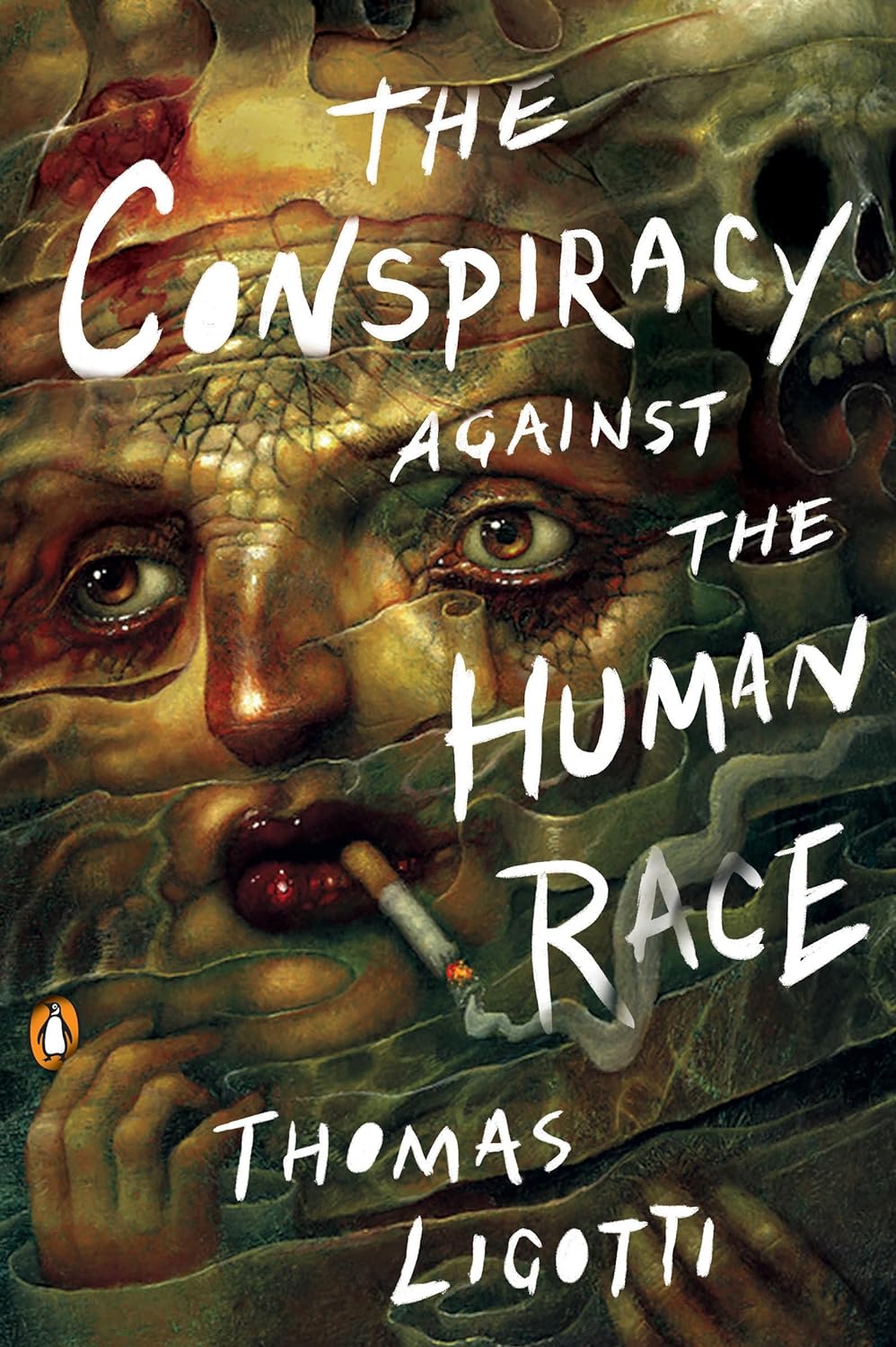
A letter I composed to a friend today, about certain experiences I had last week while visiting Chicago. After sending it, I decided to share it here as well.
While I was in Chicago, I listened to Thomas Ligotti’s The Conspiracy Against the Human Race as an audiobook while taking evening walks along the lake. I also walked backwards through the Field Museum’s excellent exhibit about the evolution of early life on Earth, from soup to dinosaurs. (The backwardsness was accidental. The exhibit means to also serve as a dramatic build-up for the visitor’s encounter with the museum’s crown jewel, SUE the T. rex skeleton, and its various megafossil contemporaries. But we somehow managed to find an alternate entrance to SUE’s chamber, after spending a lot of time in another exhibit about Ancient American cultures, and so started there instead.) The content of the evolution exhibit wasn’t anything I hadn’t seen many times before, of course, but I found the presentation fresh and welcome. I especially enjoyed the way that mass-extinction events were depicted in the walk-through timeline, each of which bathes the visitor in eerie red light as they tread across a jagged red fissure set into the floor.
There was also the inevitable floor-to-ceiling timeline that showed how very little time H. sapiens has resided on the planet. I found this timeline to pair startlingly with an inscription on the wall of the Ancient Americas exhibit suggesting that progress, something you and I were born into and thus tend to assume is an eternal axiom of the universe itself, is actually a very recent development which the vast majority of human history simply did not much concern itself with. Humans have always used their mutation of consciousness to creatively and rapidly adapt to their ever-changing world, racing ahead of other species which can only adapt at the speed of evolution. But progress, as we think of it today—the drive to lift all of society to some higher or better state, in-place, for its own sake—is something quite new, even when seen on a scale of mere millennia.
And all of these inputs, the book and the timelines and the eerie red lights, seem to have chemically bonded with memories of certain media I’ve consumed in the past, and catalyzed a new, personal ability. I can now, at will, shift my perceptive frame from my ego-centric default—seeing myself as a self-contained, self-controlled, self-sufficient traveler through the World—to one where I see myself (or, perhaps, my “self”) as one temporary and nameless wave of matter and energy bobbing along the surface of a planet, rolling and colliding for a little while among fellow accidents, innumerable across the vastness of time. And when I’m in that frame, I have the sense less of a discrete identity and more as an expression, one fractal-tip rising from a vast curve that I share with every other living being, human or otherwise. (Zoom in on my coordinates of the graph and see the further fractal-tips representing the living cells of my body, perhaps, or my gut flora, and all the still-smaller structures contained in turn within them, recursively.)
It feels, in a way, like I can peek behind a veil, any time I want to. Doing so still takes a conscious act, and the veil drops back into place the moment I return my attention to any earthly matter. This is the gift I have received from the unprescribed combination of Ligotti’s book and the science museum, which bonded with memories of Alan Watts lectures and other past teachings that have long interested me, but which lay largely inert in my mind before finding ignition through the stimuli I found in Chicago.
The above is the more positive outcome of what I extracted from Ligotti’s work, which has more generally served as my introduction to Philosophical Pessimism—a philosophy which very much earns its label, in tone and in content. I doubt I’ll consider myself a full adherent to it, taking it up as a practice in the way that I have with Stoicism. But learning its core principles has clarified many paths of thought for me, encouraging me to explore them in my own way.
For instance, I learn how one stance that emerges naturally from Philosophical Pessimism is antinatalism, a term for a thoroughly developed and many-voiced set of ideas that I hadn’t encountered before reading this book. While it’s not a club I intend to join any time soon, learning about this viewpoint, and the explorations that thinkers before me have already accomplished and published, sheds unexpected light on certain knotty problems about the value of life and its creation I’ve long held in my own mind. It has already helped me to work at them further.
But it is also, as my partner would say, deeply depressing, and I must stay mindful to tread further through these dark, red-lit hallways with caution.
To share a response that links to this page from somewhere else on the web, paste its URL here.
If you enjoy Fogknife, you might also like these websites. (See also an expanded edition of this list.)
 jmac@jmac.org
 @jmac@masto.nyc