You have just read a blog post written by Jason McIntosh.
If you wish, you can visit the rest of the blog, or subscribe to it via RSS. You can also find Jason on Twitter, or send him an email.
Thank you kindly for your time and attention today.
Introducing Crawlspace, an online-play tool for the tabletop role-playing game His Majesty the Worm. It helps you play Worm online with up to five friends, by managing the virtual deck of tarot cards that the game uses as its sole randomization element. In particular, Crawlspace offers a full implementation of the Worm “Challenge Phase”, the GM-versus-players tactical card game which resolves combat and other sticky situations that can happen during Worm sessions.
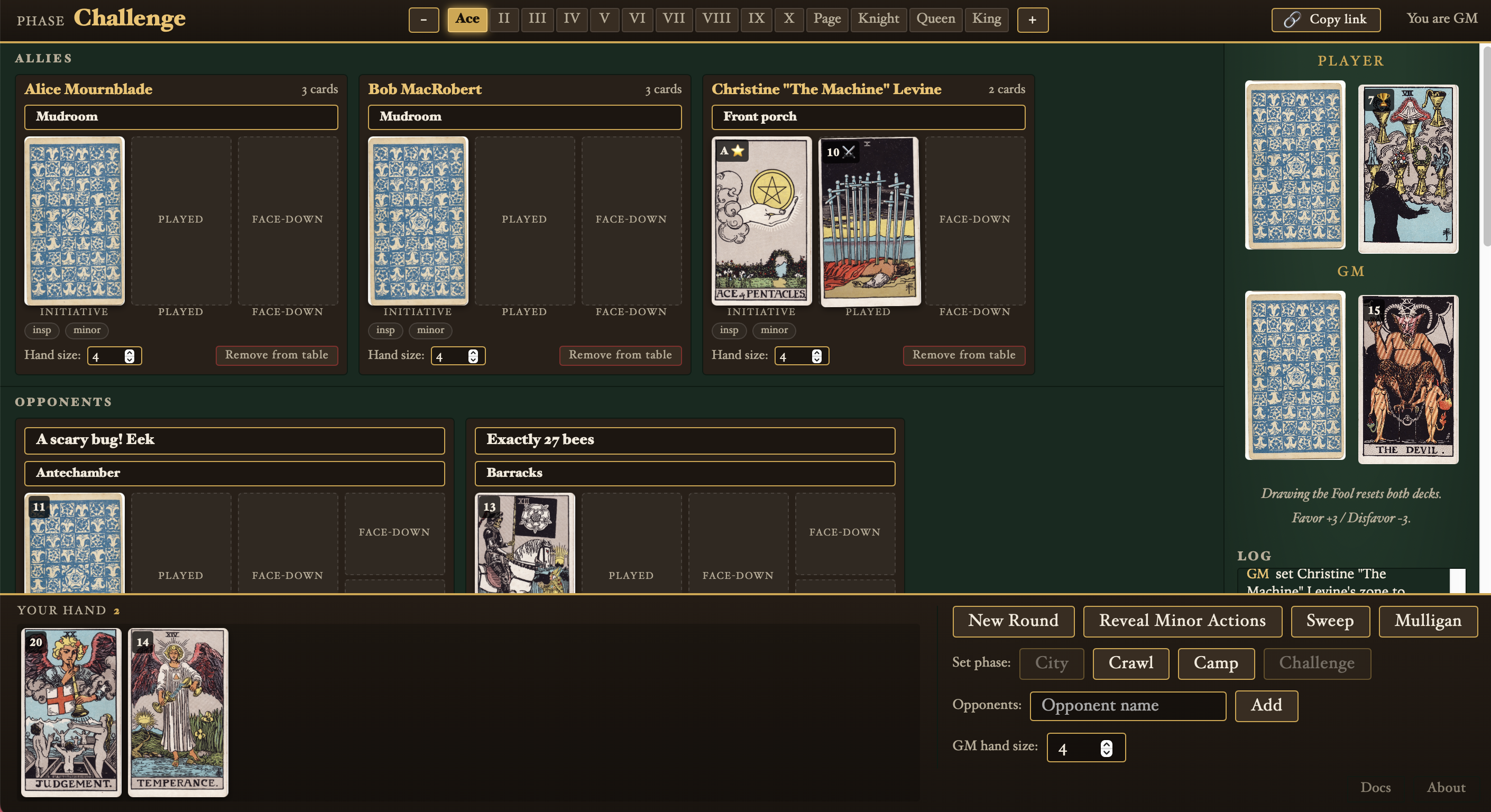
Crawlspace doesn’t to try be a do-everything Worm app: it focuses on helping you share a virtual tarot deck in ways specific to Worm. To actually play the game online, you must still provide a way to share maps with other players—I use Owlbear Rodeo for that—and some sort of telecommunication channel as well. As screen-intensive as this is, I’ve successfully used Crawlspace to have a great time running a Worm session over hotel WiFi while traveling, with only my laptop screen available, so I consider it a Thing that Works.
I’ve written full documentation for it, and welcome all feedback.
I discovered His Majesty the Worm at the end of March, wholly by accident, shopping online for Mörk Borg supplements in order to use up some expiring coupons that I’d picked up the previous winter at PAX Unplugged. The description hooked me instantly and, after asking my regular gaming group if they’d be interested in trying it, I splurged on the hardback edition.
It’s another member of the larger “OSR” family that I’ve been exploring since my visit to PAX let me discover Mörk Borg and scads of other rules-light, theme-heavy TTRPGs for every taste. Worm is, admittedly, on the rules-heavier side; rather than taking the zine-length “Here’s some lore and random tables, go!” OSR approach, Worm expresses its highly specific, narrowly defined theme through its rules, resulting in an intriguingly strange ruleset that fills out its 400-page manual.
The player-characters of any Worm game are “adventurers”—which is to say, dungeon perverts—who live as tolerated outcasts within The City, underneath which is The Dungeon. Each character has a single Quest: some specific and discrete thing that can only be found in The Dungeon, an absolutely terrible place which no person in their right mind would ever want to descend into otherwise. And these adventurers naturally blob together into Guilds, little themed groups of weirdos sharing some common thread of affinity. (Rat Queens is, in fact, an acknowledged inspiration for this game, as is the manga Dungeon Meshi and its anime Delicious in Dungeon.) All guilds internally agree to take turns working towards each member’s quest-obsession, to split any loot found along the way, and to share the costs should funeral services become necessary. All this is burned into the game’s rules: player-parties are always and only groups of monomaniacal dungeon freaks, bound to find their single Needful Thing and retire, or die trying.
And as opposed to the wide-ranging possibilities of a game like D&D, life for Worm adventurers seldom strays from the loop of delves into the depths followed by ascents into the city to rest and resupply. It reminds me of Angband and its countless CRPG descendants, except with all the wider possibilities that human-refereed RPGs make possible. The rulebook encourages players to have their adventurers permanently mark The City with their own philanthropic or construction projects, just as the GM is encouraged to nudge the players into factional intrigues. But these breaks are short; as long as an adventurer’s Quest remains unfulfilled, back into the Mythic Underground they again go. This tension between open-ended role-playing and tightly defined, rules-bound play manifests again and again in the practice of Worm, and it really appeals to me.
After three live sessions—one of which was a “session zero” that soaked up all four hours we allotted for the rules’ procedural guild-creation script—I still have a lot to learn about Worm basics. The game’s natural pace really puts the crawl into “dungeon crawl”: so far, the group has explored only eight rooms from the rulebook’s tutorial dungeon. We can put this down to the central Worm mechanic of “the Meatgrinder”, which quite intentionally adds a layer of unpredictable friction to literally every move the players make. Whenever the guild passes between two rooms, the GM flips a card and consults a random-event table that they have prepared ahead of time. Whatever the table outputs happens in addition to whatever scripted events are connected to the room upon its discovery.
For example, say that room 12 contains the stall of a goblin potion-seller. The room’s description states how the little green entrepreneur is eager to sell his stock to the next band of adventurers passing through. Meanwhile, the GM flips a card, and consults the Meatgrinder table. Will it say that the party meets a rival guild, perhaps fleeing something nasty and in desperate need of healing? Will a war band of orcs burst into the room, looking for trouble? Or will the GM flip the ever-present card that states that a clue for one player’s current quest is in this room? Whatever’s flipped, how does the potion-seller’s presence change or even define the resulting encounter? (Is the quest-clue gathering dust in the goblin’s bargain-bin? Is one of those marauding orcs its auntie?) The answer often comes out of table-wide improvisational alchemy that spontaneously arises from the GM’s description of the unexpected combination of encounters and the players’ initial reaction to it. This overlap of encounter-layers causes unpredictable moiré patterns of role-playing that surprise the GM as much as the players.
None of the above gets into the combat, which is so weird, and the main reason I wrote Crawlspace. Clearing the decks and playing a GM-versus-players card game sure is a refreshing change from throwing down a combat map with dice and tokens. Worm combat (I decline to call it “wombat”, despite some fans’ insistence) is still in the process of growing on me, but so far I’m letting myself be charmed by the novelty of it all. I like, for instance, how each player’s hand tells them with un-dicelike certainty their chances of various actions’ success, and can therefore inform their immediate tactics. If the player drew all twos and threes this round, then plain old attacks will probably fail… but maybe they can commit those cards to helping an ally do something cool, instead. Maybe they can spend a resource to activate a special ability which works regardless of card value. Or maybe they can just bluff!
The crawl continues, for my group; perhaps they’ll set up camp, in the next session, or withdraw back to The City, in either case forcing us to exercise two other Worm sub-rulesets I’ve so far only read about. So far, we’re all having a grand time down in the mind-rending darkness together, and I recommend giving this game a look if any of what I just said sounds at all appealing.
And, yes, it might now be a little easier to play online than it used to be.
Next post: Claude-favored colors as a vibe-coding tell
Previous post: Sometimes it’s just nice to be asked
To share a response that links to this page from somewhere else on the web, paste its URL here.
If you enjoy Fogknife, you might also like these websites. (See also an expanded edition of this list.)
 jmac@jmac.org
 @jmac@masto.nyc