You have just read a blog post written by Jason McIntosh.
If you wish, you can visit the rest of the blog, or subscribe to it via RSS. You can also find Jason on Twitter, or send him an email.
Thank you kindly for your time and attention today.
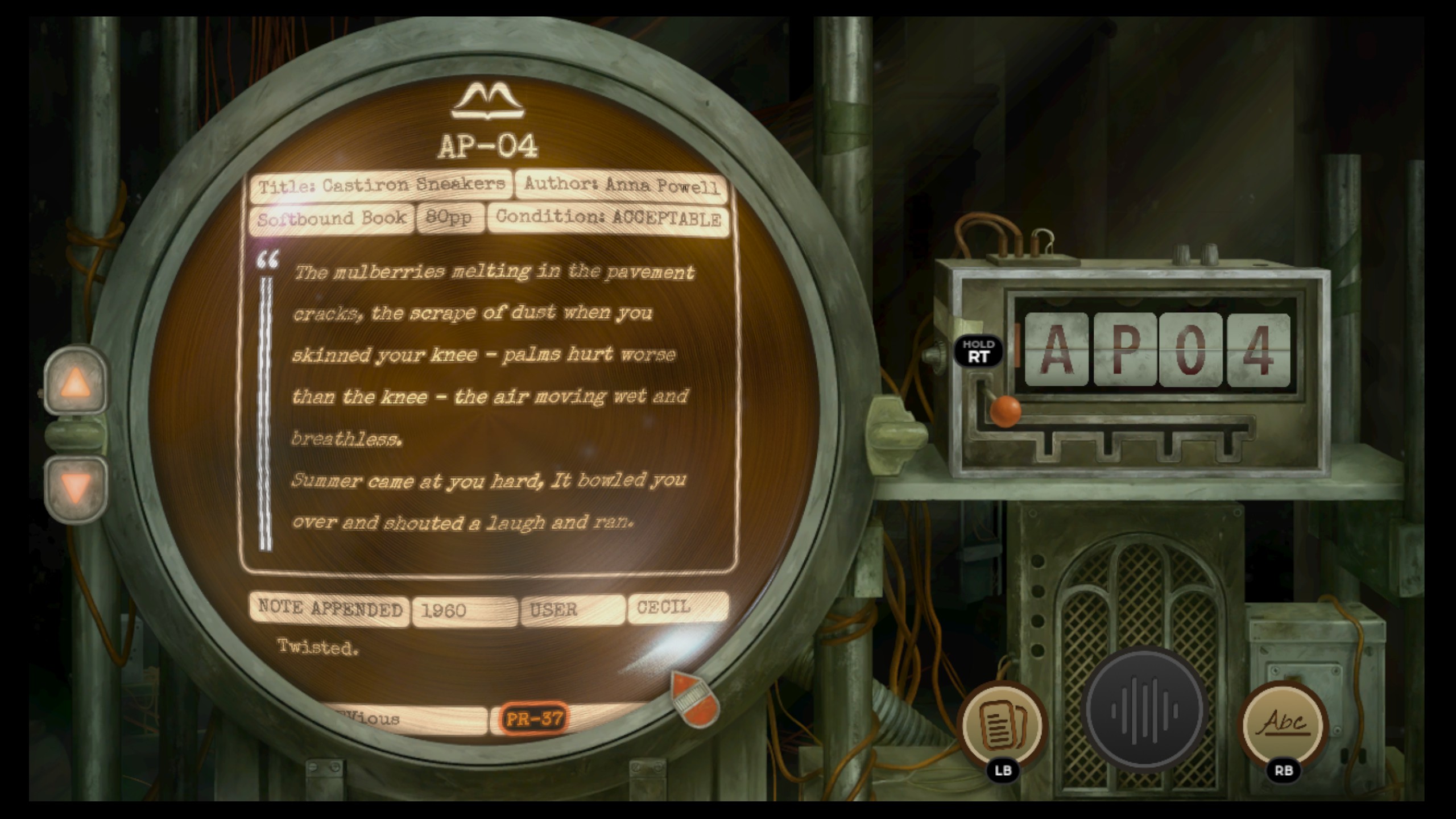
I played the database game TR-49, by Jon Ingold et al, during a micro-convalescence brought about through my annual double-jab of flu and covid vaccine boosters. After putting close to ten hours into it, I knew I was nearly done, finding the bad and okay endings while falling short of the best one. And so I stepped away to take a shower, then returned to plug in the solution that came to me during the shower, with satisfactory results. And this is how I can confidently state that TR-49 is an exemplar of its genre.
I am a fan of both Ingold’s past work and the data-deduction genre, but still I slept for most of a year on this one for no particular reason. Its minimal design does admittedly make its screenshots rather unexciting, since your character spends all her hours staring at text readouts on a Brazil-style alt-mid-century computer terminal, without the attractive images of a Her Story or an Obra Dinn. (There is plenty of high-quality voice acting, but it’s all intentionally faceless, coming in over crackling intercoms and humming speakers.) My attached screenshot—showing a database entry written by my pal Zarf, one of dozens of fan-entries spread throughout the game’s database as easter-eggy red herrings—typifies what any moment spent with the game looks like. This is certainly not a complaint, or even much of a critique, other than perhaps one towards myself for judging this particular alternate-universe memex by its fresnel-lensed cover.
The emergent story hooked me within minutes, anyway, and kept me glued to the game’s eponymous device—one imagining that LLMs were invented by a Bletchley Park power couple in post-war England—until I’d seen the mission through. As soon as it became clear who the player-character was and what she was working with, I realized how hungry I was for good fiction inspired and informed by the current AI boom, stories more nuanced and complex than the cartoonish and tweet-friendly “AI sucks and you’re a fool for using it” micro-fictions I often see on social media. The machine in the game might exist in a fantasy world, but the wonders and horrors that it’s capable of—and which it thrives upon—are grounded in the realities of LLM training. As such, the game provides intriguingly veiled commentary on present-day concerns, in the manner of all the best science fiction.
Great game.
Previous post: Protest report: ICE out of NYC, Oct 9
To share a response that links to this page from somewhere else on the web, paste its URL here.
If you enjoy Fogknife, you might also like these websites. (See also an expanded edition of this list.)
 jmac@jmac.org
 @jmac@masto.nyc